The sacking of the archaeological Museum at Ma’adi, First
Part
|
|
All
scientific and technical information, in whatever form (photograph,
drawing, text) appearing on the internet site of GREPAL
fall under the jurisdiction of French laws protecting
authors and intellectual property. Failure to observe
those laws can lead to legal pursuits.
|
|
(Second part)
The sacking of the archaeological
Museum at Ma’adi
By Luc Watrin
(June 2005)
First part: location of the site |
|
Ma’adi is a major chalcolithic era site that emerged
between 3850 and 3600 B.C. The site is located on a low
shelf of the Nile at the mouth of the Wadi-Digla, at
around 15 km upstream from Cairo. This major prehistoric
site, already heavily damaged by the Egyptian
construction companies Nerco and Ma’adi in the 1980’s,
suffered a new outrage in 2003 with the pillaging of its
archaeological museum by very informed and organized
thieves who remain to-date unidentified. At that time,
no echo of the theft rang out in the press. A vital part
of Egyptian prehistory had been sacked, and the silence
concerning the affair suggests that the affair was
carefully silenced…
The stealing of archaeological objects from Ma’adi began
without anyone being alarmed by the disappearance of
objects from the museum, nor their reappearance on the
market. The scandal of the pillaging and trafficking was
nonetheless detected in October 2004 by several members
of the GREPAL (Groupe De Recherche Européen Pour
l'Archéologie Au Levant). The Ma’adi affair had begun…
Before investigating these dramatic events for the
Egyptian cultural heritage, let’s go back to the origins
of this major site for Egyptian prehistory.
|
MA’ADI, A SINGULAR
CHALCOLITHIC STATION IN LOWER EGYPT
|
|
Ma’adi is one of the rare sites of the 4th millennium to
feature both habitations and cemeteries. It was
carefully excavated by the University of Cairo in the
1930’s at a period where in Upper Egypt prehistoric
archaeology concentrated on cemeteries alone due to the
pressure of sponsor (western museums), eager to acquire
antiquities. The originality of Ma’adi is illustrated by
the habitat, which reveals the local traditions and the
adopting of exotic models inspired by contacts with
Levantine populations. The first type of construction
consists in oval huts whose roofs were composed of
tamarisk wood posts. These huts, of local tradition, are
similar to those observed at Merimde-Benisalame, which
is a little older (5th millennium).
But the greatest architectural factor at Ma’adi, which
makes the site so original, is the presence of partially
underground structures built using both mudbricks and
stone, or constructed in limestone. These constructions
would appear to be “cellars” accessible by stone
stairways. This type of subterranean shelter is
unattested in prehistoric Egypt. Perhaps this
architectural model was meant to provide constant
coolness, even against the burning summer heat.
Yet we do not know the exact function of the partially
underground structures: were they dwellings or silos?
The excavations revealed large jars, which could make us
see the structures as silos, but in this case, how can
we explain that the most elaborate structure contained a
copper statue representing a woman holding a child? Most
of the storage jars, which still hold wheat, meat, or
dried fish, were found outside the structures.
|
 |
|
Figure 1: Stone structure at
Ma’adi-west
|
|
The most sophisticated of these constructions is
probably the most recent, to the west of the site, and
has a sub-rectangular shape. It was discovered in 1987
by Fathi Afifi Badawi, professor of archaeology at the
University El-Azhar. It is entirely made of stone, its
floor is limewashed, and it is totally comparable to
contemporary Palestinean dwellings from the Early Bronze
Age I (around 3700 B. C. On the other side of the Sinaï,
during this period, constructions are not semi-subterranean
but are subrectangular. The Ma’adians thus adapted this
architectural model for their own needs. This
exceptional Ma’adi structure is the subject of GREPAL
study from 1995-1996, and the subject of a joint
excavation project involving our group and the
University El-Azhar. This project for reopening
excavations in the western sector of Ma’adi, submitted
in 1997 to the SCA, did not succeed because the German
Institute at Cairo (D.A.I.) was informed of the
operation and did everything possible – to put it kindly
– to block the project and usurped our research and
performed a Ma’adi excavation between 1999 and 2002.
Contrarily to a widely held idea, which defends an
endogenous development of Egypt in prehistoric periods,
Lower-Egypt is in the early 4th millennium the place for
intense trade with the Levant. In adopting a Levantine
architectural model and adapting it to local
requirements, Ma’adi attests to acculturations through
repetitive contacts, and to the dynamism of its
populations that are too often seen as anchored in their
own thousand-year old traditions.
|
Original and sometimes
nearly standardized productions
|
|

Figure 2: Earth statuette from
Ma’adi |
The most
moving testimony of the Ma’adi objects is
certainly the small earth head that we have
nicknamed ‘Ma’adi-man’. Despite that, Ma’adi
produced few sculptures and most of the objects
are ceramic or stone vases. As such it is
essentially the Ma’adi vases were stolen from
the museum. The ceramic is more standardized and
attests to mass-production. Next to the great
silo-jars and red-polished ceramics which make
up around 10% of the vases (of which some have
incised points under the rim), the two most
frequent types of pottery are oval ring-based
brownware, and black globular vases. . These two
types and their variants make up around 80% of
the ceramic set.The content of the jars was
varied and doesn’t depend just on the shapes.
Analysis of the jars presents red ochre, resins,
asphalt, and even dorsal spines of catfish,
which may have been used as arrowheads… |
|
|
An evolution in
ceramic shape is attested across the occupied area. Some
of the vases have animal motifs. |
|
|
|
Figure 3: The three most
common kitchenwares in Ma’adi
|
|
Ceramic, reflecting
trade with Upper Egypt and Palestine
|
|
Ceramics are a good marker of exchanges because they are
easily transportable and are also the packaging material
for food products. The theft of the vases from Ma’adi
and the cleaning of the ceramics that followed,
especially among imported objects, makes it practically
impossible to identify the contents, and laboratory
analyses had not yet been performed. The inhabitants of
Ma’adi also produced painted bowls similar to the White
Cross-lined class bowls of Upper Egypt (and not with the
later series of the Decorated class as has been advanced
by some researchers), testimony to contacts with Upper
Egypt in an early period contemporary with Naqada I. A
few sherds of Blacktopped in beaker forms along with
local imitations reinforce that theory. In 2000, a new
concrete proof of commerce between Ma’adi and the cities
of Upper-Egypt emerged by the discovery, in what is
probably an elephant grave in Hierakonpolis, a vase
produced at Ma’adi associated with White Cross-Lined and
Blacktopped ceramic, two types of kitchenware that only
Upper Egyptians produced. We also note a few polished
red ceramics decorated with a dotted line under the rim,
probably from Ma’adi, in the graves of Upper-Egypt like
the one discovered in grave 1783 of the Great Cemetery
of Naqada that we place in the Naqada Ia period.
|
 |
 |
|
Figure 4:
Palestinian jar with wavy handles |
Figure 5: Palestinian juglets.
On the left, an import, on the right, a locally-made
copy
|
|
|
Palestinian vases with light paste and white slip (cream
ware) with wavy horizontal handles may indicate the
importing of oil from southern Palestine at the opening
of Early Bronze Age I. Other containers such as juglets
in grey ceramic suggest a relation ship with northern
Palestine during the same period. Palestinian ceramics,
arriving in Ma’adi as part of the oil trade, is also
imitated locally as illustrate these small double-vases
decorated with incisions under the rim. They are typical
of contemporary Palestinian productions.
|
Stone and metal
|
|
Trade with Palestine thus led to transmissions in
architecture and ceramics. But it also brought on
changes in lithics. Local stone tools at Ma’adi are
rudimentary, involving flint chipped on only one side,
but it integrates a more elaborate foreign aspect
including large Palestinian-type sickle blades and large
tabular scrapers (fan-shaped), along with a few tools
typical of the Naqada I culture (U-shaped blades,
discoidal maces).
|
 |
|
Figure 6: Discoidal maces imported
from Upper-Egypt
|
|
One of the most prestigious and emblematic kitchenware
productions of Ma’adi is the stone vases, most of which
are in light grey basalt. A vein of basalt providing the
raw material for the Ma’adi productions is located near
the “Haddadin Lava flow”. The characteristic shared by
the pottery and the basalt vases is the presence of a
ring base, a trademark of Ma’adi craftsmen. The basalt
vases at Ma’adi are exported to Upper Egypt, where they
are frequently found in graves from the Naqada I-IIa
period, but also in Jordan, as evidenced by a recent
discovery at Tell Hujayrat el-Ghuzlan.
|
 |
 |
|
Figure 7:
Basalt vases from Ma’adi |
Figure 8: “Top hat”-type stone
vases
|
|
|
Lastly, Ma’adi was home to what in the current
state of science is the earliest metallurgical
industry in Africa, producing copper axe-heads,
hooks, and statuettes. The raw materials were
imported from regions to the East (copper from
Feinan in Jordan, asphalt from the Dead Sea).
Trade in these materials was facilitated by the
domestication of the ass, whose remains are
found at Ma’adi and in Palestine in contexts
contemporary with the opening of the Early
Bronze Age I. |
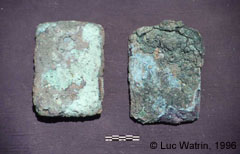
Figure 9: Copper ingots
imported from Jordan |
|
The
origin of this emblematic civilization
|
|
There is no enigma concerning the origin of Ma’adi,
contrary to what some researchers have suggested (e.g.
Stan Hendrickx), but there is large foreign (Palestinian)
origin its population, just as there was earlier in the
northern Delta in the first Buto village (phase Ia).
This phenomenon of population migrations from Palestine
to the Delta, that can be attested as of 4000 B.C. at
Buto then at Ma’adi, takes place in the context of
regular exchanges between the two regions going back to
the Natoufian. From 9000 B.C., Aspatharias-type Nile
shells are found in Palestine at the stations of Abu-Gosh
and Mallaha, attesting to contacts with Egypt.
|
Funerary aspects
|
|
Contrarily to graves at Merimde-Benisalame, which
apparently overlapped the inhabited area and which
are the most ancient yet known in the Nile Valley,
the cemeteries at Ma’adi are located outside of the
village. In reality there exist at least two
distinct cemeteries: the first, to the south of the
dwellings, includes 76 graves; the second cemetery,
still further south, counts 471 graves. The graves
are simple elliptic trenches in which the deceased
was placed, in contracted posture with the hands
brought close to the chest and to the face. Every
other grave held offerings of crude pottery, shells,
flint blades, ivory combs, or palettes. The
potteries are identical to kitchenware found in the
dwellings. Individual animal graves, sometimes
bearing offerings, sometimes appear among the graves
of humans, without forasmuch being in a specific
area within the cemetery. This may have some
spiritual meaning, possible foreshadowing of the
coming religion, burying animals with the same
respect as homo sapiens. We find this arrangement on
a contemporary site of Heliopolis.
|
The brainteaser of
chronology
|
|
Ma’adi is the main establishment of chalcolithic
culture in Lower Egypt. Though other such centers as
Heliopolis and Buto Ib existed, Ma’adi is the only
predynastic village to have been excavated on such a
great scale. In Upper Egypt it is difficult to get
an idea of the dwelling of this region because they
have largely been ignored (El-Kab), is residual (Hierakonpolis),
or poorly excavated (El-Adaima). The southern Delta
village came after the neolithic 5th millennium
villages of Merimde-Benisalame and El-Omari. Yet the
relative chronology of this great prehistoric site
had long been problematic: most researchers placed
Ma’adi too late, in the Gerzean (Naqada IIc-d,
around 3500-3300 B.C.)., or else much too early in
the Ghassoul-Beersheva (Palestinian Chalcolithic,
around 4500-3900 B.C.). Our own works performed
directly on Ma’adi archaeological artifacts in the
1990’s, along with survey work on the site, lead to
results falling on a middle-ground: they demonstrate
that Ma’adi is essentially contemporary with the
first part period of Naqada (Naqada Ia-IIa), from
Buto Ib and early in the southern Palestinian Early
Bronze Age (EB Ia1). A set of radiocarbon dates
confirms this chronology and places Ma’adi around
3850-3625B.C.
|
 |
|
Figure 10: Inter-regional commerce
during the Ma’adi period
|
|
Second part: the museum
robbery |
| |
|
|
|
|
Luc Watrin with a student of Professor I. Rizkana
on the site of Ma'adi, 1995 |
 |
|
|
| Museum
of Ma'adi |
 |
|
|
|
|


